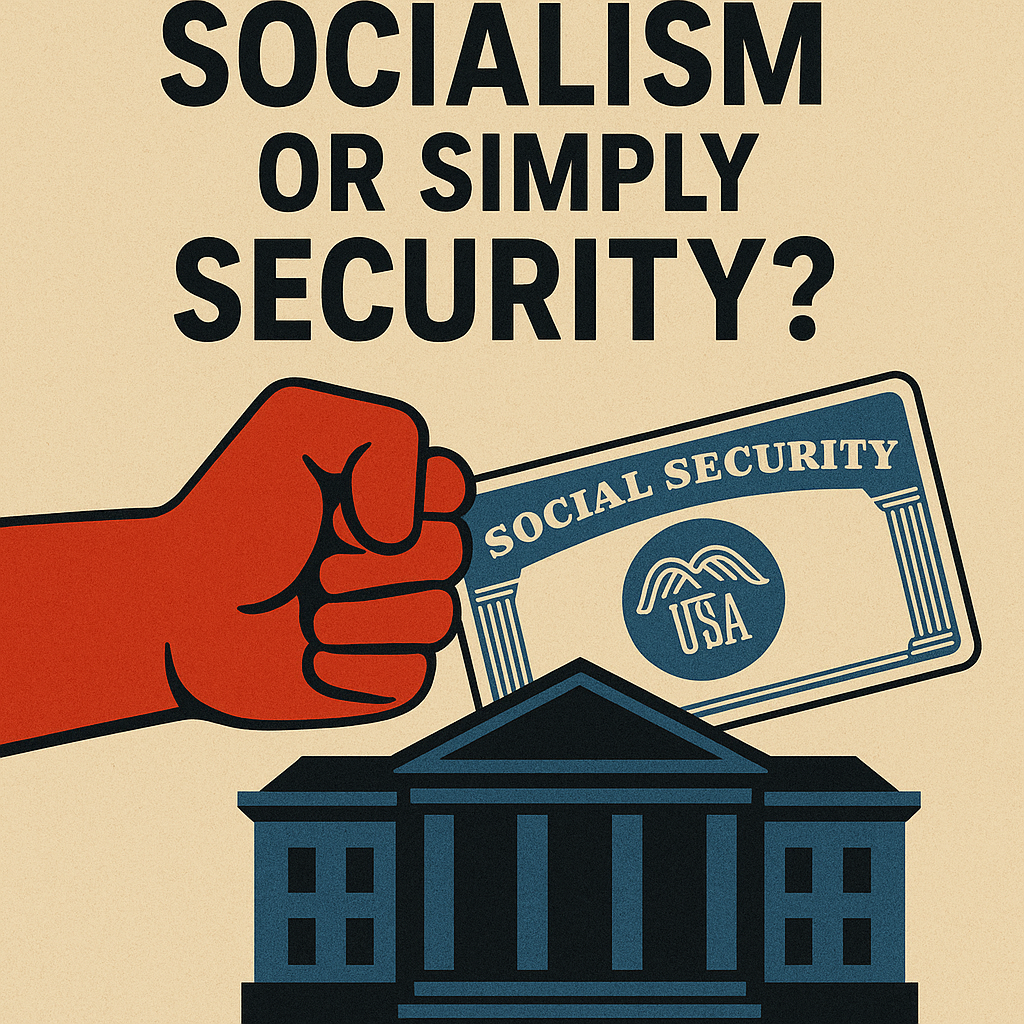
Is the Social Security Act an act of Socialism?
First things first: what is socialism… and what is not?
A workable definition (with unflattering precision)
At its core, socialism is a social and economic doctrine that calls for public (or collective) ownership or control of property and productive resources—especially the “means of production.” Encyclopedia Britannica+2Merriam-Webster+2
That umbrella contains many flavors, but the family resemblance usually looks like this:
-
Not merely regulating private enterprise
-
Not merely taxing and spending
-
But shifting ownership/control of major productive assets away from private hands and toward the public, the state, or collective ownership. Encyclopedia Britannica+2Merriam-Webster+2
(**It would help if you were lawyer or student of the law when reading some of these descriptions. Basically saying “government controlled” but with a twist.)
“It’s a bad word!” — especially in America
In the United States, socialism is often used as a BLANKET descriptor: one broad category across any government program someone doesn’t like. A policy helps the poor? “Socialism.” A regulation slows business? “Socialism.” A tax is inconvenient? “Socialism.”
As so many things often do in the mind of the ‘uninformed’, the word ‘socialism’ often means what you wish it to mean, depending on the mood, the audience, and the political climate. So before we label anything, we should do the boring adult thing and ask:
What is it about Social Security that gives it the “color of socialism?” Is it simply because it’s government mandated?
Or is it something else entirely?
What the Social Security Act was—and why it happened
The Social Security Act was signed into law by President Franklin D. Roosevelt on August 14, 1935. Social Security+2Social Security+2
The Act did several things, not just one. It established federal old-age benefits and built a broader framework that included items related to unemployment compensation and other welfare provisions. Social Security+1
Context matters (whether we like it or not)
CONSIDER THE CONTEXT: The Great Depression began in the wake of the 1929 market crash. By the time Roosevelt took office, the country was a wrecking yard: bank failures, shattered confidence, and unemployment that reached roughly 24.9% in 1933, by common estimates. FDR Library+1
So yes—this law was NOT drafted in a calm, leisurely era of national confidence. It was passed under pressure. The country needed stability. Older people needed income security. The political system needed to show it could still function.
(On the other hand, if you look at statistics for that time: when it came to the “retirement” aspects of the act: life expectancy was so low, and the ‘FRA’ or ‘full retirement age’ set so high, that it appeared very few would ever cash in on the system.) But retirement was NOT the only consideration.
Now—was it “benevolence”? Was it “legacy”? (Well, we all know that motive-reading presidents is a parlor game.) The question is “what did the law actually do.”
What Social Security is:
“Social Security” (as most Americans mean it today) is the OASDI program:
OASDI = Old-Age, Survivors, and Disability Insurance. Social Security+2Social Security+2
That name matters because it answers a big misunderstanding: Social Security is not just “retirement.” It also includes benefits for eligible survivors and disabled workers. Social Security+1
How Social Security works (fact-checked, no myths, no fake news…)
Social Security is a government-mandated social insurance program financed primarily through payroll taxes. Social Security+2Social Security+2
And here’s the key point that people either don’t know—or pretend not to know:
It is not a personal savings account—
Your payroll taxes are not deposited into a private account with your name on it, sitting there “earning interest” like a retirement fund you personally own.
Instead, payroll tax revenue is used to pay benefits as they come due, and the program operates with trust funds that hold special-issue U.S. Treasury securities. Social Security+2Social Security+2
“Trust funds” doesn’t mean a vault of cash
The Social Security trust funds are financial accounts that hold these special-issue securities. When the trust funds need money to help cover benefits, securities are redeemed and interest is paid according to law – and Treasury operations. Social Security+2Social Security+2
That’s not a moral argument. That’s simply the operational reality.
“Do you get it back?”
You don’t get a “refund.” You qualify for benefits based on insured work and statutory formulas—because this is insurance, not a personal piggy bank. Social Security+2Social Security+2
“What if you die first?”
If you die before collecting much (or any), Social Security may still pay benefits to eligible survivors (spouses, children, etc.), depending on your insured status and their eligibility. Social Security+1
So the simplistic “they stole my money and I get nothing” rant is usually incomplete at best.
So… is Social Security “socialism”?
Now we can actually answer the title question without waving our arms around.
If socialism means public ownership/control of the means of production, then Social Security is not socialism.
It does not nationalize industries, seize factories, turn private companies into state property, or replace markets with public ownership. Encyclopedia Britannica+2Merriam-Webster+2
What Social Security is, very specifically, is social insurance: a mandatory pooled system, funded by payroll contributions, designed to provide income support in retirement, disability, and after death for qualifying survivors. Social Security+2Social Security+2
So if someone calls Social Security “socialism,” one of two things is happening:
-
They don’t know what socialism means, or
-
They know, but they’re using the word as a club—because the label is doing the work they don’t want to do.
The real issue: Americans argue with labels, not definitions
A lot of people shout “socialism” when what they really mean is:
-
“I don’t want to pay taxes.”
-
“I don’t trust government.”
-
“I resent forced participation.”
-
“I think people should fend for themselves.”
Those are arguments—they can be debated. But they are NOT reasons to classify the Social Security Act as socialism!
Words matter—definitions matter!
Socialism must NOT become shorthand for, “Any government program I dislike.” If that happens, ‘socialism’ stops being a meaningful term, and becomes nothing more than a political cuss-word.
Which is exactly how it’s used most of the time.
Conclusion
So here’s the clean verdict:
-
The Social Security Act (1935) was a major New Deal-era law signed on August 14, 1935, amid severe national crisis. Social Security+1
-
Social Security (OASDI) is a social insurance program—Old-Age, Survivors, and Disability Insurance. Social Security+1
-
It is not socialism under the standard meaning of socialism, because it does not socialize ownership of the means of production. Encyclopedia Britannica+2Merriam-Webster+2
So to criticize Social Security as having ‘socialistic’ intentions, is completely disingenuous.
If it is simply something you don’t like, then criticize it honestly: consider first its sustainability, incentives, funding, fairness, politics—but don’t call it socialism because it not the personal savings account that so many assumed it to be.
If you would like to be a contributing member:
Share This Story:


Leave A Comment
You must be logged in to post a comment.