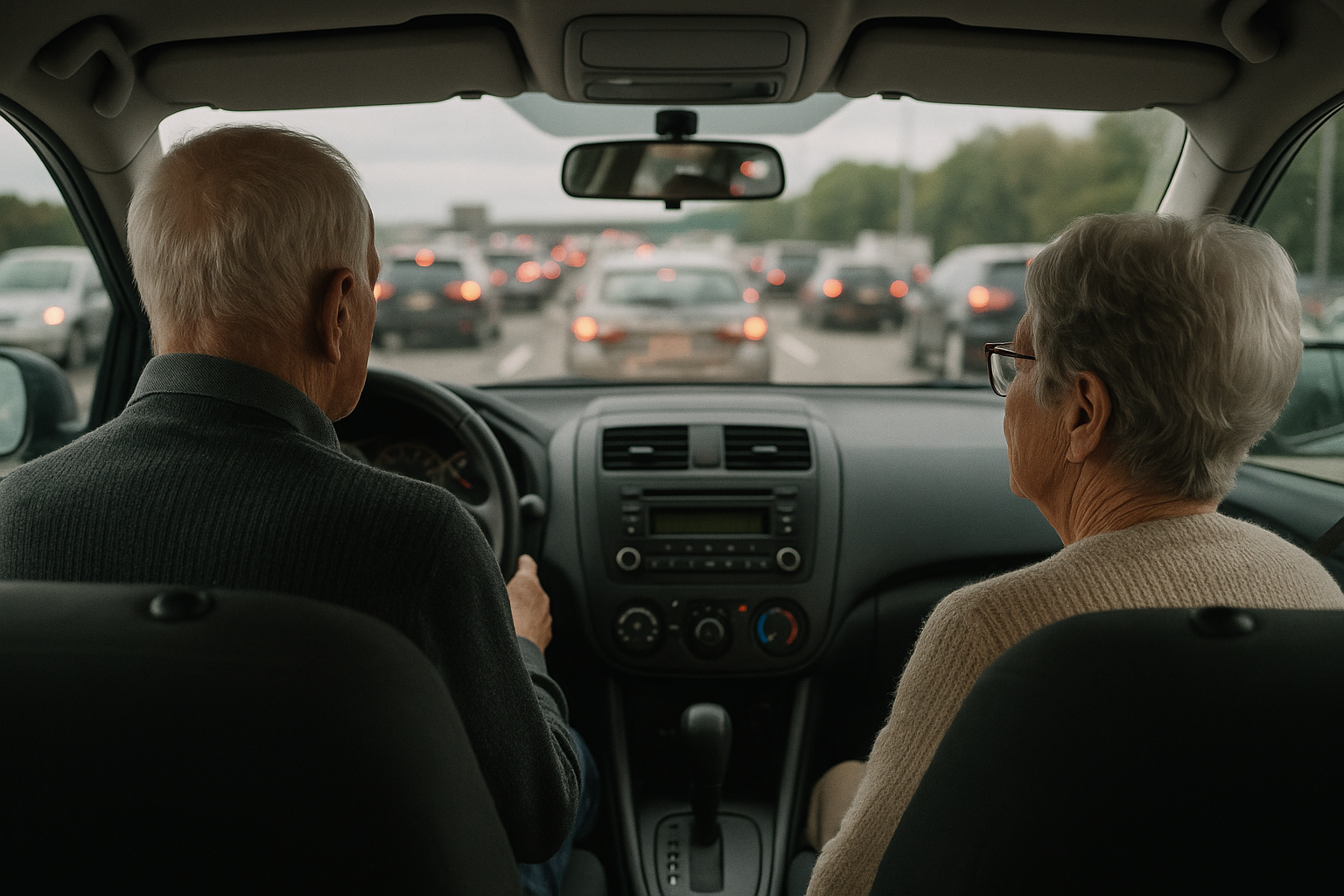
Driving is Driving Me Crazy!
As a senior citizen I’ve never had an accident, but a lot of people behind me have!
We live in central Florida now! When we moved to Florida, we thought we’d escaped the craziness of the big city driving.
Then we visited Orlando! Not only does Orlando have great amusement parks, you also get to spend many desperate hours of your precious retirement time—just trying to get to them!
Driving on I-4, well, it’s not just a journey, it’s an adventure! Putting your life on the line (most deadly highway), or sitting and waiting for hours just to move a few miles!
Or if you want to ‘really‘ have a driving good time, you should go to Miami! (A word of advice, take your blood pressure meds before you go.)
Of course, this issue is not exclusive to ‘Florida’ — there are many, and from what I hear, far worse to contend with in other cities like Los Angeles, New York, et al.
In fact, we had the—what should I call it—privilege? Yes, the privilege of living in Chicago for a couple years where our daily commute was about 15 miles on one of the infamous Illinois, eight-lane toll roads.
We would speed along for about two miles, then come to dead stop 🛑, creep along for three or four miles more, and then—ZOOM—off you go again for another two or three miles, and then we’d stop 🛑again, and creep along for more miles … wash, rinse, repeat, until you finally reach your destination.
A fifteen mile journey that consumed three to four hours of our daily life!
Believe it or not, some people (the millennials and Gen-x types, I assume) find that lifestyle exciting! Of course, they vape their medications and likely drink while they’re driving to cope with it! Or not…I don’t know.
Don’t Trip without your TripTik!
Do you remember the “Triple A” (AAA) company? (They still exist you know!) Many years ago they had what you might refer to as “a paper GPS.”
We married in the 1970’s and our travel always included an AAA map, or a “TripTik,” as it was called.
Their maps were usually very up-to-date, and often in the form of a book that took you step-by-step through your journey. That was the TripTik and it got us to-and-from with minimal issues. Unfortunately, the “paper GPS” could not tell us about accidents, lane closing, detours, or the like.
Well, guess what? They now have TripTik Travel Planner online and through their AAA Mobile App, which lets you:
- Get real-time traffic and construction updates.
- Map gas prices and EV charging stations.
- Build multi-stop routes and save them for later.
- Even locate discounted AAA partner hotels along your path.
In other words, the paper TripTik grew up, went to college, and got a degree in data science.
But Is ‘TripTik’ The Only Option?
The open road doesn’t have to be intimidating. There are a number of technologies that act like a second set of eyes, a gentle voice of reason, and sometimes even a guardian angel whispering, “Turn left in 200 feet”— if you want to get there on time.”
There Are Several New Road Companions: Tech That Keeps Seniors Confident on the Road
- Google Maps — The Gold Standard of Guidance – (This is what we use, and I can vouch for it’s accuracy, dependability, and ease of use.)
- Waze Maps— The “Neighborhood Watch” of the Road
- Apple Maps — Simplicity for iPhone Loyalists
These satellite fed apps detect slow or heavy traffic congestion, construction zones, and suggest detours or optional routes. They give you vocal, turn-by-turn directions so that you don’t miss a turn or an exit. Some are subscription based, some have limited free versions. It all depends on your needs.
There Are Also Specialized Safety Apps (Subscription or free versions)
- Life360: — it lets family members see where Mom or Dad is and receive automatic crash alerts. – (Again, we use this for our children to track us.)
- Roadtrippers: Helps plan scenic drives with rest stops, diners, and motels marked in advance. Great for couples with a nostalgic road-trip spirit.
- iOnRoad (Android only): A driving assistant that uses your camera to alert you if you’re following too closely or drifting out of the lane.
In-Car Tech Has Come A Long Way: On-board Vehicle Safety Equipment
We have all had close calls when backing or attempting to change lanes, only to find someone in our blind-spot.
The new tech in today’s cars are real lifesavers to us retirees, and as a user of each, I can HIGHLY recommend them.
Newer vehicles are practically guardian angels on wheels:
- Adaptive cruise control: Maintains safe distance automatically. No more back-and-forth from brake to gas; the system does it for you.
- Blind-spot monitoring & lane-departure warnings: Subtle nudges that prevent big mistakes when your mirrors fail you.
- Voice-activated dashboards: No fiddling with buttons — just speak and go. (In our case, we use SIRI on our iPhone. It will do most things to keep my hands off the phone while driving.
If a senior’s car doesn’t have these built in, aftermarket gadgets, you can refer to something like Garmin Drive-Smart units. These are high-tech at a low cost, usually between $150 – $300. Or, there are more sophisticated and higher-end devices, if you wish.
The Human Backup — Family Tech Support
Recommended more than anything, is to set up shared location tracking like those available through Google Maps or Life360, et al. It allows your kids or caregivers to check in without nagging. When they wish, they open the app on their phone and they can track your progress in real-time, knowing at all times exactly where you are.
Personally, I call all of the Senior Sitters a digital peace of mind — the modern version of “Call me when you get there.”
Final note: Just be careful out there, today’s world is total road anarchy, and like Forrest Gump said, “You never know what you’re gonna get.”
IF YOU LIKE WHAT YOU READ, CLICK THE BUTTON BELOW TO LEAVE A COMMENT:
Share This Story:


Leave A Comment
You must be logged in to post a comment.